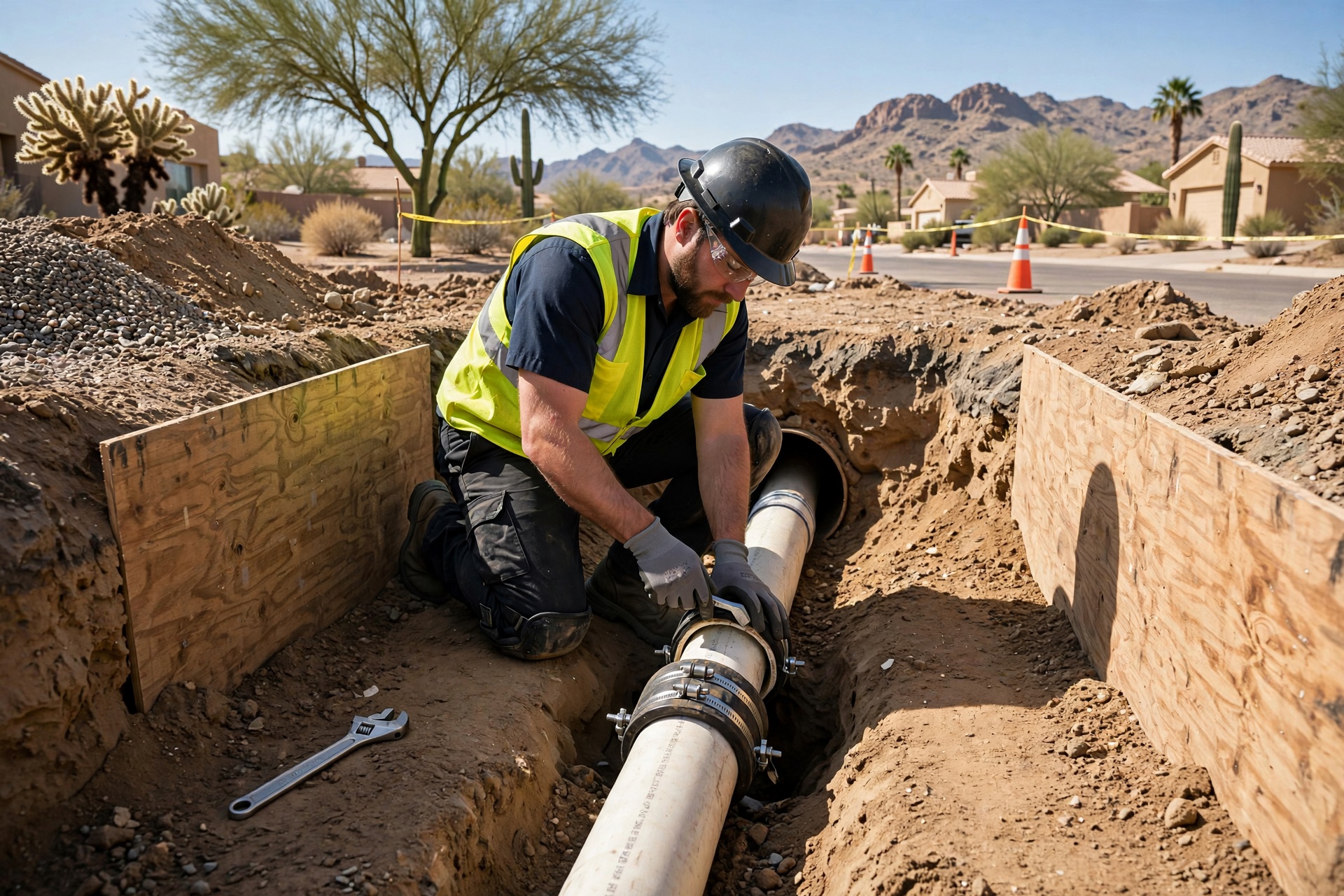
In Tempe’s hot desert climate, sewer lines under homes in South Tempe and near Papago Park often develop bellies when sandy Maricopa County soil shifts after monsoon rains or from repeated expansion during 110-degree summers. These low spots collect grease and paper, leading to recurring backups that standard snaking cannot fix. A proper repair requires locating the exact sag with camera equipment, then deciding between spot excavation or trenchless methods depending on pipe material and depth. Older housing stock near Mill Avenue frequently has clay or cast-iron lines that crack when bellies form, so we always inspect the full run from the cleanout to the street connection before any work begins.
Repair work in Downtown Tempe must account for narrow easements and proximity to Tempe Town Lake infrastructure, which limits heavy equipment access. We map the belly relative to property lines and irrigation lines common in the area, then use sectional replacement or pipe bursting to restore grade without disturbing mature landscaping. Homeowners in neighborhoods bordering Phoenix and Chandler sometimes see bellies worsen after nearby construction vibration, so we document pre-existing conditions with video before starting. Every job includes a post-repair camera pass to confirm the line now maintains consistent slope to the main.
Code requirements in Tempe call for minimum fall on repaired sections, and we pull permits when excavation exceeds hand-dig depth. Soil conditions here are alkaline and abrasive, so we use PVC or HDPE rated for local conditions rather than reusing old materials. Edge cases include multiple bellies on long runs from South Tempe homes to the street, which require staged repairs to avoid collapse during the job. We always advise customers to schedule during milder winter months when possible, since extreme summer heat makes extended excavation harder on both crew and equipment.
Technician insight
In Tempe the thing that catches most people out with sewer line belly repair is how fast the alkaline soil and extreme summer heat make an existing sag worse once it starts collecting solids. Homes near South Tempe and the lake often have shallow laterals that shift after every monsoon, so a small belly can turn into a full backup within one season if left alone.
South Tempe Home With Recurring Kitchen Backup
A homeowner near Guadalupe Road reported slow drains after heavy summer use. Camera work showed a belly 18 feet from the cleanout where clay pipe had settled in sandy soil. We replaced the sagging section with PVC set to proper fall and restored the compacted yard. Follow-up inspection confirmed consistent flow to the main with no standing water.
Sewer Line Belly Repair Services We Offer
✓Camera Inspection for Belly Detection
Locates exact sag points and measures slope loss using video equipment before any digging begins in Tempe properties.
✓Trenchless Belly Repair
Restores line grade using pipe bursting or lining methods that minimize yard disruption common in established South Tempe neighborhoods.
✓Sectional Pipe Replacement
Removes and replaces only the sagging section of sewer line when the belly is isolated and pipe material allows clean cuts.
✓Belly Prevention Slope Correction
Regrades short runs or installs cleanouts to maintain flow after a belly is removed, reducing future issues in Maricopa County soil.
✓Emergency Belly Backup Clearing
Clears immediate blockages caused by bellies while scheduling permanent repair for homes near ASU or Mill Avenue.
Sewer Line Belly Repair Cost in Tempe, AZ
| Service | Typical Range | What Affects It |
|---|---|---|
| Camera inspection and belly mapping | $175–$325 | Price varies with line length and cleanout location. |
| Trenchless belly repair | $2,800–$5,200 | Depends on pipe diameter and distance to street connection. |
| Sectional excavation repair | $1,900–$3,600 | Higher when multiple bellies or deep lines are present. |
| Additional cleanout installation | $450–$750 | Recommended when original cleanout is hard to reach. |
Ranges are typical for Tempe, AZ and confirmed with an exact written quote before any work starts.
How it works
- 1
Initial Camera Assessment
We run a camera from the exterior cleanout to map the belly location, depth, and pipe condition relative to the home’s layout in Tempe.
- 2
Access Planning
We identify the least disruptive entry point while checking for irrigation, utilities, and property boundaries typical in Downtown Tempe and Papago Park areas.
- 3
Repair Execution
We excavate or use trenchless methods to eliminate the sag, install new pipe with proper fall, and backfill with native soil compacted for local conditions.
- 4
Final Verification
A second camera pass confirms restored slope and flow before we restore the surface and review maintenance steps with the homeowner.
Pricing
Cost depends on depth, access, and whether trenchless methods are feasible in the yard.